Jane Smiley Quote “He’d said, “Remember that Chinese curse, ‘May you live in interesting times
Eric Frank Russell Quote “May you live in interesting times and come to the attention of

The Use of the Phrase 'Interesting Times'. The notion that 'interesting times' means chaotic or troubled times seems to date back, within English-speaking cultures, to before the phrase 'may you live in interesting times' emerged. In a letter sent in August of 1914, for example, we find the following:
Jane Smiley Quote “He’d said, “Remember that Chinese curse, ‘May you live in interesting times

The earliest citation that has yet come to light is U-Turn, a sci-fi short story by Duncan Munro (one of the pen names of Eric Frank Russell), 1950: "For centuries the Chinese used an ancient curse: 'May you live in interesting times!' It isn't a curse any more.
Eric Frank Russell Quote “May you live in interesting times and come to the attention of

"May you live in interesting times" is an English expression that is claimed to be a translation of a traditional Chinese curse. While seemingly a blessing, the expression is normally used ironically; life is better in "uninteresting times" of peace and tranquility than in "interesting" ones, which are usually times of trouble.. Despite being so common in English as to be known as the "Chinese.
"May You Live in Interesting Times" Meaning What Does This Idiom Mean? • 7ESL

Living In Interesting Times. "May you live in interesting times.". This phrase, often attributed to Chinese philosopher Confucius who lived around 500BCE, is commonly cited as the translation of an ancient Chinese curse. Interestingly, though, no definitive Chinese source for this saying has ever been found.
Eric Frank Russell Quote “May you live in interesting times and come to the attention of

On March 11, Newman's memoir "May You Live in Interesting Times" will be released on Audible. In the book, Newman recounts the road to showbiz success, including her stint studying with.
Eric Frank Russell Quote “May you live in interesting times and come to the attention of

The expression may you live in interesting times is always used ironically to wish someone difficulty and trouble in their life. In other words, it's far from a blessing and much closer to a curse (more on that in a moment). As a refresher, irony is the use of words to express a sentiment or idea other than their literal meaning—in fact.
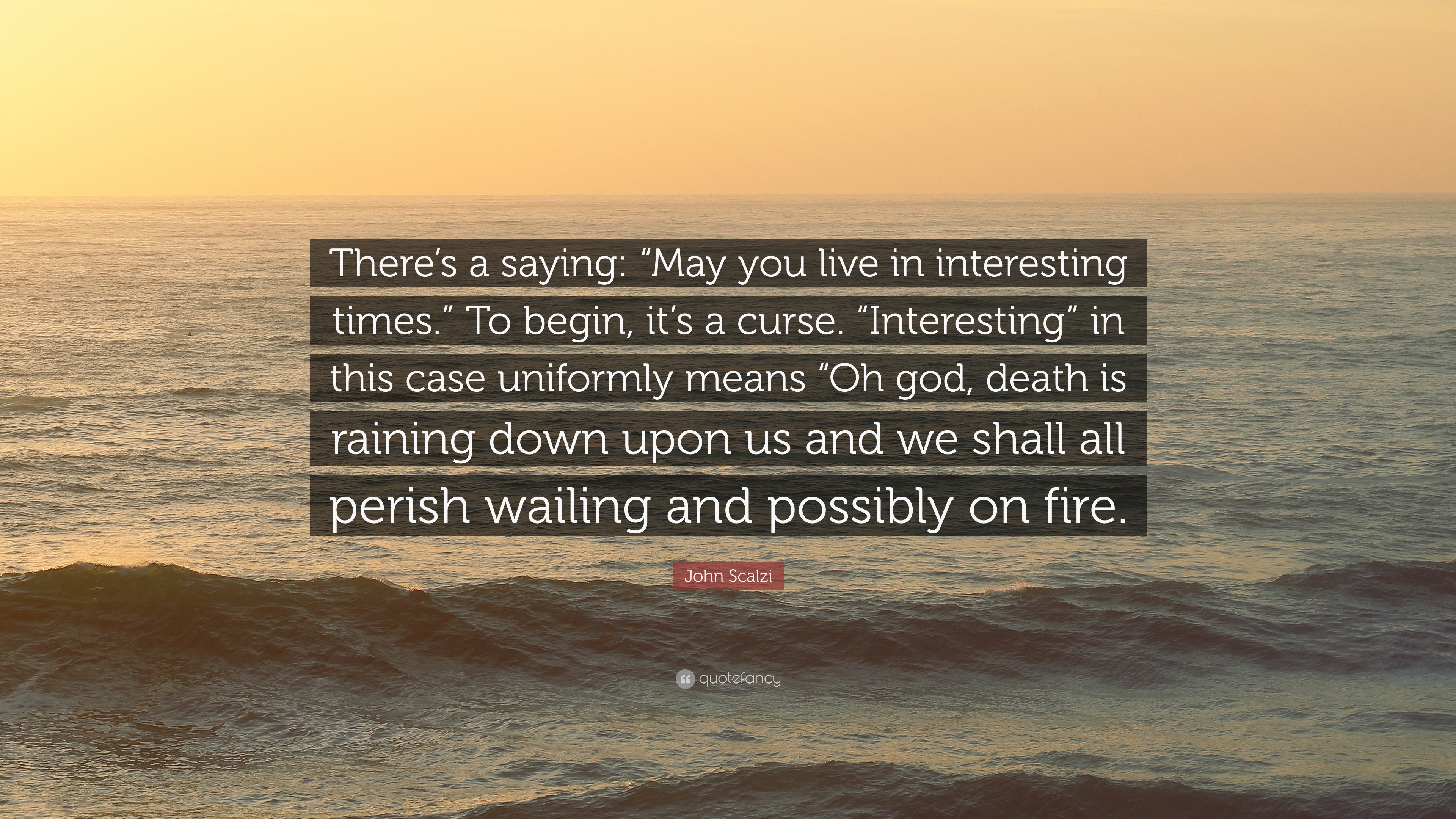
John Scalzi Quote “There’s a saying “May you live in interesting times.” To begin, it’s a
' May you live in interesting times': the writers who lived through the middle decades of the seventeenth century would have understood the ironies and implications of that supposed Chinese curse. Some raised arms or joined plots or were imprisoned, some lost their lives in those interesting times: Lucius Cary, Viscount Falkland, died at the battle of Newbury; Sir John Suckling died in.
May you live in interesting times / digital download / Etsy France

Interesting Times Quotes Showing 1-30 of 107. "Whatever happens, they say afterwards, it must have been fate. People are always a little confused about this, as they are in the case of miracles. When someone is saved from certain death by a strange concatenation of circumstances, they say that's a miracle. But of course if someone is killed.
May You Live In Interesting Times Quote ShortQuotes.cc

May you live in interesting times" is an English expression that is claimed to be a translation of a traditional Chinese curse. The expression is ironic: "interesting" times are usually times of trouble. Despite being so common in English as to be known as the "Chinese curse", the saying is apocryphal,.
May You Live In Interesting Times Quote ShortQuotes.cc

The term 'may you live in interesting times' may sound like a polite phrase but it is actually quite the opposite. The term is used to wish someone chaos and disruption in their life. Origin of the phrase. The phrase 'may you live in interesting times' is believed to have its origins in an ancient Chinese curse.
May You Live in Interesting Times 1 Thessalonians 51618 YouTube

In 1966 Robert F. Kennedy delivered a speech that included an instance: 19. There is a Chinese curse which says "May he live in interesting times.". Like it or not, we live in interesting times. They are times of danger and uncertainty; but they are also the most creative of any time in the history of mankind.
May you live in interesting times / digital download / Etsy France

For Chinese-language profanity, see Mandarin Chinese profanity. " May you live in interesting times " is an English expression purported to be a translation of a traditional Chinese curse. Despite being so common in English as to be known as " the Chinese curse ", the saying is apocryphal, and no actual Chinese source has ever been produced.
May You Live in Interesting Times / Digital Download / Etsy

I have always enjoyed the quote, May you live in interesting times. Initially, I believed it to be a well-wish, but I later read it was an old Chinese curse. However, extensive research conducted by Quote Investigator suggests that there is no substantial evidence to support the claim that this saying originated as an ancient or modern Chinese curse.
Eric Frank Russell Quote “May you live in interesting times and come to the attention of

The Phrase Finder website says: "'May you live in interesting times' is widely reported as being of ancient Chinese origin but is neither Chinese nor ancient, being recent and western.". According to the site, the phrase was originally said by the American politician, Frederic R. Coudert, in 1939. He referred to a letter Sir Austen.
Eric Frank Russell Quote “May you live in interesting times and come to the attention of

In a June 6, 1966, speech at the University of Cape Town to the National Union of South African Students, Kennedy said: "There is a Chinese curse which says 'May he live in interesting times.'. Like it or not, we live in interesting times.". So where do we think the saying comes from?
I’d like to live in a less interesting time now, please. Tribrach for those who love (or

Popularly attributed to Chinese, but this is apocryphal; the true origin is unclear. See May you live in interesting times § Origins on Wikipedia. Phrase [edit] may you live in interesting times. A sardonic curse disguised as well-wishing, where interesting times refers to trouble.