How To Say Little Sister In Korean Here's a list of translations. Download Free PDF and ePub
[Let's learn Korean culture] How do people in Korea call their parents and their older siblings

In formal situations, such as when addressing someone older or showing respect, you can use the word "sister" in Korean by saying "언니" (eonni). This term is used by a female to address an older sister or any older female acquaintances respectfully. It is pronounced roughly as "uh-ni" but spoken quickly with a gentle intonation.
𝐋𝐞𝐚𝐫𝐧 𝐊𝐨𝐫𝐞𝐚𝐧... 𝙃𝙤𝙬 𝙩𝙤 𝙨𝙖𝙮 ' 𝙎𝙞𝙨𝙩𝙚𝙧 ' 𝙞𝙣 𝙆𝙤𝙧𝙚𝙖𝙣... YouTube

1- Benefits of Being Older in Korea. 1. You can order 동생 (dongsaeng) "young fellows" to do things for you. If you're older (either 오빠/형 oppa; hyung/hyeong or 언니/누나 unni/unnie; noona/nuna) and want to ask someone to bring you something or do things for you, you're allowed to do this simply because you're older.
'Sister' in Korean language! 5 meanings of 'Unnie' in KOREA Basic Korean, pronunciation

Language: Korean. Reading time: 8 minutes Published: Jun 7, 2021 Updated: Sep 17, 2021 SHARE "Family" in Korean: Talking About Your Family in Korean. Younger sister's husband: 매제 (mae-je) Grandparents in Korean. To talk to or about your grandparents in Korean, you would say: Grandparents: 조부모님 (jobumonim)
How To Say Younger Sister In Korean A Simple Guide EmergeWomanMagazine

A younger brother or a younger man will use the Korean word. 누나 (noona) to address a female friend who is older. Nuna is the opposite of oppa. While oppa is used exclusively by females when addressing older males, nuna is used exclusively by males when addressing older females. You may also see 누나 spelled as "Nuna.".
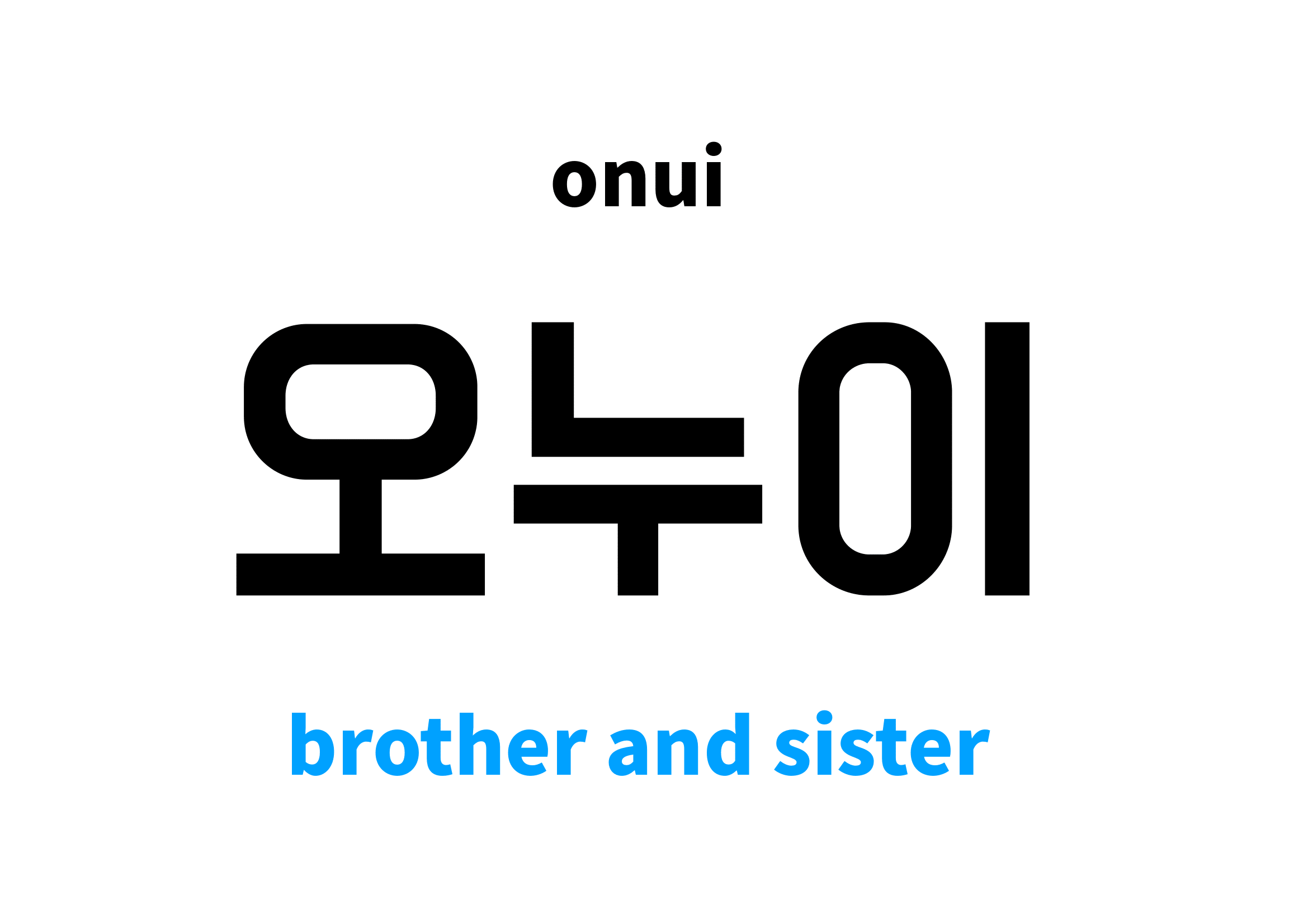
brother and sister in Korean 오누이's meaning and pronunciation
Informal Ways to Say "Little Sister". In casual or familiar settings, you can use more colloquial terms to address your little sister: 막내 (Maknae): This term refers to the youngest in a group, including family members. It is a cute and endearing way to refer to a younger sibling. 누나 (Nuna): If you are a male, you can use this term.
Younger Sister in Korean Language JayviontuHarrison

아가씨 (ah-ga-ssi) — husband's younger sister. 서방님 (suh-bang-nim) — husband's younger, married brother / husband's sister's husband (서방님 may also be used to just mean "husband.") Wife's Side. These are the terms that a husband would use to refer to his in-laws. Wife's Parents:
A Simple Guide on How to Say Little Sister in Korean EmergeWomanMagazine

Today, we will learn how to call younger sibling in Korean. This may sound strange to some of you, because in English, we just say older and younger in front of the sibling words (brother or sister) to describe the age relationship between the siblings. However, in Korean, there is specific term to designate younger sibling. LEARN KOREAN FOR.
Younger Sister in Korean Language

Instead, you can refer to a family member by their family title: mom, dad, niece, brother, etc. family: 가족 (kajok) parents: 부모님 (bumonim) grandparents: 조부모님 (jobumonim) [paternal] grandfather: 할아버지 (harabeoji) [paternal] grandmother: 할머니 (halmeoni) [maternal] grandmother: 외할아버지 (oehalabeoji)
Learn Korean Language for Beginners All about Korean Greetings in 5 minutes 한국어 배우기 인사안녕하세요

Formal Ways to Say "Younger Sibling" in Korean. In formal contexts, such as talking to elders or using honorific language, you can use the following expressions: 1. 남동생 (namdongsaeng) This term is used to refer to a younger brother. "남" (nam) means "male" or "man," and "동생" (dongsaeng) is the term for "younger.
21 111 Suryun Lee's Korean I am writing a letter to my sister Korece, Öğrenme

Overview. Ji-sung, a Korean wave star living in Macau, invites his wife's cousin to live in Japan. Minwoo's wife, Mika, is a fan of intelligence and is soaked with the anticipation of meeting her favorite celebrity. Ji-sung, a Korean wave star living in Macau, invites his wife's cousin to live in Japan.
Younger Sister in Korean Language AuroraoiAyers

Here is how to say sister in Korean: 누나 [noo-na] for older sister and 여동생 [yeo-dong-seng] for younger sister. If you would like to use the universal term for 'female sibling', you can use the term 여자 형제 [yeo-ja hyung-jae] which literally translates to female sibling in Korean. However, it is an less commonly used term when.
Korean sister tattoo ideas! Tattoos! Pinterest Sister tattoos, Sisters and Korean

The direct translations for oppa, hyung, nuna, and unnie are: Oppa meaning: older brother. Hyung meaning: older brother. Nuna meaning: older sister. Unnie meaning: older sister. At first glance, oppa and hyung and nuna and unnie have the same translation. However, the actual meanings are quite different than the translations in English.
Learn Korean Learn Basic Korean Vocabulary & Phrases with Dom & Hyo
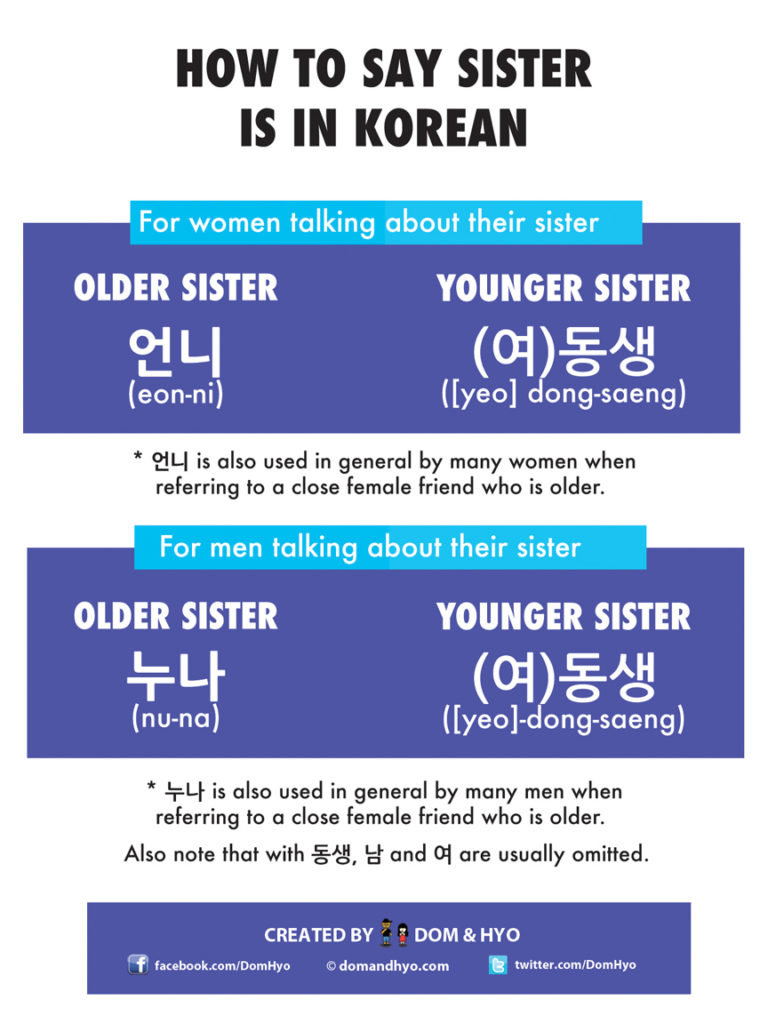
If you are female, the Korean word for sister is 언니 (eonni). If you are male, the word for sister is 누나 (nuna). However, the word for sister, which is 여동생 (yeodongsaeng), can be used by any gender. Below, we will go into more detail about when this is possible. "Younger sister" in Korean. The word for younger sister is.
Learning Korean Korean words, Korean language, Learn korean

Dongsaeng means "younger sister/brother", and is gender neutral. Dongsaeng is a bit tricky to use, since you wouldn't directly call a younger sibling that on a daily basis. Find out how to use it below. 1. Actual younger sister/brother. To emphasize that she or he is your biological sister/brother, you add "chin" or "nae" before.
Formal and Informal Words in Korean Korean language, Learn korean, Study korean

Younger sister in Korean: What's Korean for younger sister? If you want to know how to say younger sister in Korean, you will find the translation here. You can also listen to audio pronunciation to learn how to pronounce younger sister in Korean and how to read it. We hope this will help you to understand Korean better.
Learn How to Talk About Your Family in Korean

In formal situations, it is important to use appropriate language to show respect. When addressing your younger sister in a formal setting, you can use the term "여동생" (yeo-dong-saeng). This term is a combination of "여" (yeo), meaning "female," and "동생" (dong-saeng), meaning "younger sibling.". Together, they.